
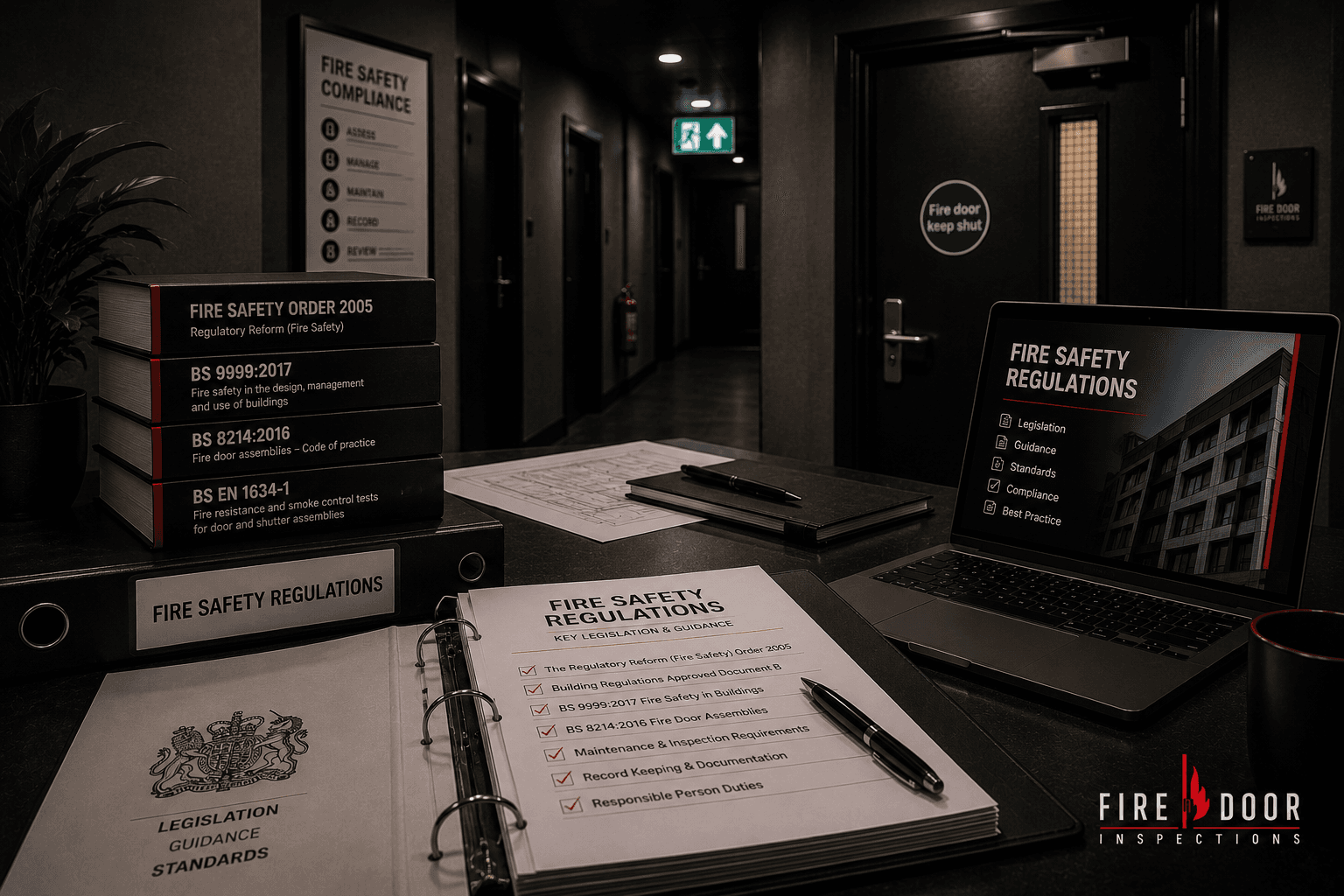
Compliance Guidance
Regulatory Reform (Fire Safety) Order 2005 and Fire Door Inspections
Plain-English guidance for duty holders and responsible persons on how fire door management and fire door inspections may support fire safety records in England and Wales.
- General fire safety guidance
- Responsible Person context
- Fire door inspection records
- Reports where recorded
- London property support
- Not legal advice
Important: General Guidance, Not Legal Advice
This page provides general information only and is not legal advice. Fire safety duties depend on the property type, occupancy, risk profile, management arrangements and applicable legislation. Duty holders should seek competent fire safety advice where needed.
Overview
What Is the Regulatory Reform (Fire Safety) Order 2005?
The Fire Safety Order is a key piece of fire safety law in England and Wales.
In plain terms, the Regulatory Reform (Fire Safety) Order 2005 (often called the Fire Safety Order or RRO) places duties on the Responsible Person to manage fire safety risks and take reasonable steps to keep people safe from fire.
It applies to many non-domestic premises and to relevant parts of residential buildings where fire safety duties arise. Fire doors are commonly part of a building's fire safety arrangements — including compartmentation and protected escape routes — but this page does not provide legal interpretations of the Order.
For England-specific regulations that may also affect certain residential buildings, see our Fire Safety (England) Regulations guidance. For wider compliance topics, visit the compliance hub.
Duty Holders
Who Has Duties Under the Fire Safety Order?
Responsibility depends on who has control of the premises or workplace — the exact position varies by building and management arrangements.
- Employers
- Building owners
- Landlords
- Managing agents
- Facilities managers
- Freeholders
- People with control of premises
- Responsible Persons
Fire Doors
Why Fire Doors Matter Under Fire Safety Duties
Fire doors are part of wider fire safety management — not a standalone compliance checkbox.
- Fire doors help compartmentalise fire and smoke
- They support protected escape routes
- Damaged, altered or poorly maintained doors may reduce protection
- Doors should be checked, maintained and recorded as part of fire safety management
- Visible defects may be identified through structured inspection
Inspection Records
How Fire Door Inspections May Support Fire Safety Management
Inspections help identify visible defects and create records — they do not replace a fire risk assessment or guarantee legal compliance.
Learn about our fire door inspections, reports and compliance support for practical next steps after findings are recorded.
Identify visible defects
Inspections can record door leaf, frame, seals, closers and hardware condition where observed during agreed scope.
Create a record of observed condition
Reports document what was checked and what was observed at the time of inspection, subject to access on the day.
Support decision-making
Defect notes and priority guidance may help duty holders plan remedial works and contractor instructions.
Do not replace a fire risk assessment
Fire door inspections focus on visible door condition. Wider fire safety management should be reviewed through appropriate assessments and advice.
Do not guarantee legal compliance
Inspection reports document observations. They do not prove or guarantee statutory compliance.
Part of broader fire safety management
Records, maintenance, remedial works and periodic review work together alongside competent fire safety oversight.
Documentation
What Records Should Be Kept
Record-keeping expectations depend on the premises and applicable duties — the list below reflects common fire safety management practice.
- Fire door inspection reports
- Fire risk assessments
- Remedial works records
- Maintenance logs
- Re-inspection records
- Contractor or competent person documentation
- Communications with managing agents, landlords or duty holders
- Door schedules and defect tracking where maintained
Related Guidance
Relationship With Other Regulations and Guidance
Fire safety duties may involve several guidance topics alongside the Fire Safety Order.
Fire Safety (England) Regulations
Guidance on fire door records and responsible person duties under England-specific fire safety regulations.
Read topic →Responsible Person Duties
Understand the role of the responsible person or duty holder and how inspection records may support internal management.
Read topic →Building Safety Act Context
A cautious overview of how building safety record keeping may relate to fire door inspection planning.
Read topic →Fire Door Inspection Frequency
Why inspection frequency depends on building type, risk, use and management arrangements.
Read topic →Fire Door Checklist
Common visible fire door items that may be checked during inspections.
Read topic →Compliance Hub
Explore fire door compliance topics, checklists and inspection frequency resources.
Read topic →
Next Steps
Practical Next Steps for Duty Holders
A proportionate approach to fire door management alongside wider fire safety arrangements.
- 01
Review fire door condition
Consider current door use, previous defects, maintenance history and any fire risk assessment actions relating to fire doors.
- 02
Arrange inspection where appropriate
Book a structured fire door inspection where agreed scope, access and reporting requirements are confirmed in advance.
- 03
Record findings
Keep inspection reports, door schedules and defect notes as part of internal fire safety documentation.
- 04
Prioritise defects
Use report guidance to plan remedial works, contractor briefs and follow-up actions with competent persons where needed.
- 05
Complete remedial works where needed
Address recorded defects through suitable repair, replacement or further specialist assessment as appropriate.
- 06
Keep evidence and review periodically
Maintain remedial records, re-inspection notes where applicable and review arrangements as building use or condition changes.
Fire Door Inspections
Need Fire Door Inspection Records for Your Premises?
Structured fire door inspections and reports can help duty holders record visible condition, support remedial planning and maintain clearer documentation — without guaranteeing legal compliance.
FAQ
Regulatory Reform Fire Safety Order Questions
General answers about the Fire Safety Order, responsible persons, inspections and record keeping.
Does the Regulatory Reform Fire Safety Order mention fire doors?
Who is the Responsible Person under the Fire Safety Order?
Is a fire door inspection the same as a fire risk assessment?
Can a fire door inspection prove compliance?
What records should be kept after a fire door inspection?
How often should fire doors be inspected under fire safety duties?
Is this page legal advice?
Can you provide fire door inspections in London?
Related Information
- Compliance hub
- Responsible person duties
- Fire Safety (England) Regulations
- Building Safety Act
- Inspection frequency
- Fire door checklist
- Fire door inspections
- Fire door reports
- Remedial works support
- Fire door re-inspections
- After inspection guide
- Inspection vs maintenance guide
- Landlords
- Property managers
- Sample report
- Get a quote
- Contact